Sunday, August 21, 2011

€10 "gypsy pants" and €3.5 shoes

If I had known 2 years ago that I would soon travel around Europe with more than 20 other architecture students: visiting ancient castles and palaces one day and mosques and cathedrals the next; admiring Zaha Hadid buildings one moment and hitting up the Colosseum or the Pantheon right after; eating gelato in the middle of piazzas, the smell of crepes underneath the Eiffel Tower...I'd probably have tried harder to fight off food coma in that dark lecture room of ARCH 170.

All throughout the summer I was a little angry at myself for not being able to recall more facts from bspace lecture slides, kostof's textbook, and even Professor Shanken's voice.
But what I realized was that classes can't teach you the experience of being there, how it feels to walk in the middle of narrow streets that weren't paved for cars while looking up at building facades detailed with ornaments; the aerial photograph of the Mezquita in a lecture slide can't convey the mosque's massiveness when viewed from human perspective on the street; neither the descriptive texts nor the pictures of the Sagrada Familia in a book can justify the sense of overwhelming awe experienced when looking up at the basilica in person...

What I liked most about having studio in Guardamar was the chance to really being there, understanding the history of the city while becoming familiar with the streets, the beach, the castle, the dunes, and even the native people. In the previous studios I've taken, although professors usually assign sites that were within the bay area, most of us never had time to revisit the sites more than once or twice, and relied mostly on Google map aerial views to guide our diagrammatic understandings. Thus, by the end of spending two months in Guardamar, I felt more attached and knowledgeable about my project site and its surrounding context than I have for most of my previous studio projects.

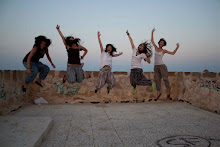
One night after studio, some of us went shopping at the local street market at the dunes near our project site. I'm not really sure how we somehow all decided to get these pants that were baggy, thin and loose. We called them the "gypsy pants". Their colored stripes made them look like pajamas upon first glance, but they are tightened near the ankle. I have never seen these in the States, but they seem to be quite popular in Spain. Perhaps to better integrate ourselves into Spain for the summer, we just thought we gotta get us some Spanish pants! Jinah was the first one to get her pair that night, and the rest of us got our pairs at the Mercadillo on Wednesdays before studio.
All of us were also eyeing these Spanish shoes from the shoe store right across from the Pension. So we all got them too. Afterall, these shoes came in all kinds of colors, looked like they could be Toms, and were also dirt cheap (at about $5).

Since we all matched, what could be better than a photoshoot at the Guardamar castle during the week of final review?

I remember on our way up to the castle, the natives stared at us like we were nuts. I remember laughing so hard while taking these pictures that the few groups of visitors must have thought we were nuts too.

But seriously, what are these pants? I felt like Aladdin the whole time I was wearing them.

view of the city of Guardamar and the beach in the background


A few days ago, a friend asked me, in a very serious tone, why would anyone ever pay money to buy those pants and those shoes. I didn't really answer her, but I have a feeling that if she was there, she would have done the very same thing with us. Sometimes pictures can't justify the experience of being there. Meanwhile, those pants, those shoes, and a few little souvenirs, became the only concrete touchable reminders that I was there, as a part of Guardamar Del Segura, in the summer of 2011.


I'm never going to forget this.


-Lu Han-


Friday, August 19, 2011

From Slide Show to Real-life Experience

This summer, beside doing projects in the studio, I also got some chances to visit important architectural landmarks that i have studied in the architecture history class (ARCH 170 A/B) and also in the studio.
It was a truly different experience to see architecture in real life from only seeing it through slide show or picture in class. So, here are some sites that i visited the last summer:
1. Alhambra, Granada, Spain (ARCHi 170A)


2. Mesqita, Cordoba, Spain (Archi 170A)


3. Parc Guell, Barcelona, Spain (ARCHI 170B)


4. Sagrada Familia, Barcelona, Spain ( ARCHI 170B)
5. Casa Milla, Barcelona, Spain ( ARCHI 170B)

6. Casa Batillo, Barcelona, Spain ( ARCHI 170B)
7. German Pavillion, Barcelona, Spain (ARCH 170B)


8. Colosseum, Rome, Italy (ARCH 170A)

8. Piazza del Popolo, Rome, Italy, (arch 170 A)

9.Piazza Navona, Rome, Italy, (ARCH 170 A)

10. St Peter basilica, Vatican city, (ARCH 170A)

11. Sistine chapel, Vatican city (ARCH 170A)

12. Basilica di Santa Maria Maggiore, Rome, Italy (ARCH 170A)

13.Pantheon, Rome, Italy

14. Pallazo vecchio , Florence ,Italy, (ARCH 170 A)

15. Pallazo Uffizi , Florence, Italy (ARCH 170A)


16. Basilica di Santa Maria del Fiore, Florence, Italy (ARCH 170A)

17. Ponte Vecchio, Florence, Italy (ARCH 170A)

18. Pisa Cathedral and leaning tower, Pisa, Italy (ARCH 170A)


19. Eiffel tower, Paris, France (ARCH 170B)

20. Musee du louvre, Paris, France (ARCH 170B)

21. Notre dame , Paris, France (ARCH 170B)
22. Institute du Monde Arabe, Paris, France, (Studio 100B)

23. Centre du Pompidou, Paris, France (ARCH 170B)

24. Caixa Forum, Madrid, Spain (Studio 100B)
-Sherrilyn Mulyono-

Wednesday, August 17, 2011

Tea House/Mansion

The tea house, like us, is a foreign object in the Spanish world. It takes over an hour to drive through desolate, rural Spain to reach the place, and mid-way through the trip you begin to feel as if Alex is planning to leave you in the middle of the desert. Upon arival, you feel like you've flown to Morocco or some Islamic country, for the architecture and the residents there match that culture.

The objective of the tea house is pure relaxation and conversation. You can find nice couches and pillows in multiple rooms in the house, and numerous rugs outside to sit. Tea comes next, and you can follow that with hookah or probably other substances not listed on the menu.

The tea house was one of the most intersting places I encountered over my trip. I expected the tea and the hookah, but the house itself was such a surprise. The architecture and the huge scale of the grounds was unexpected. I also never thought I'd see peacocks, cats, and baby dogs running around the place while I sat and enjoyed my tea.

This place was a gettaway from real life. When we came here, we forgot about our school work and presentations, and were able to enjoy something different. Classmates and teachers became pure friends, and we were able to experience everything as equals. Most of our trips away from Guardamar were intended to let us discover new things, but I feel that at the tea house we reflected on things that we had already found.


Zackerias

Tuesday, August 9, 2011

Experience of a Lifetime


Just a few months ago none of us knew that Guardamar del Segura existed and now we leave this place with many memories and stories to tell people back home. I can still recall the day we all got there and we did not know what to expect, that was also the day we met Vicente. I'm not going to lie, but Vicente definetly made our stay in Guardamar even more special and worth wile. Nonetheless, a large portion of this program was dedicated to travel and that is something I did not take for granted. I enjoyed every trip we had, whether big or small. I'm going to bring to memory some of the great moments I enjoyed during my summer in Spain:


1) Arriving to Madrid and experiencing a different country for the first time.


2) Arriving to the Pension.

3) Eating some of Vicente's food for the first time.


4) Being able to see Roman ruins.


5) Alicante Castle.


6) The beautiful beaches of Guardamar.


7) Alicante Float Burning.


8) Granada weekend!


9) Valencia Weekend, traveled to 6 cities (Altea, Valencia, Pamplona, San Sebastian, and Bilbao).


10) Guardamar Festival, Moors and Christians.


But I guess what I enjoyed most of all is having the oportunity to meeting new people, see new places I only knew through books, and experience life in a new country.


Thank you to all that made this summer one of the most memorable summers of my life,


-Roberth


Saturday, August 6, 2011

Guardamar del Segura studio has given me the opportunity to go beyond Wurster style studio and be able to experience a real life case study. Living in this small resort town allows the student to delve into the culture and history of a case study on a first hand basis. The limited access to information from internet or a library system encouraged us to focus on the project and the analysis of the town and sites by visiting and sketching from a primary source research perspective. Students also learned from participating in presentations and guided tours from historians and archaeologists that helped us understand the history, architecture, and laws governing the ruins and ancient archaeological sites. The class was also complimented with local site visits to Phoenician and Islamic ruins. In order to expand our understanding of the national and Mediterranean architecture and history, field trips to major cities in Spain were incorporated. The Castle in Alicante, the Alhambra in Granada and the Mezquita in Cordoba for example contrasts the modern architecture of Santiago Calatrava's Ciudad de Artes y Ciencias in Valencia. One of the most important ways of learning architecture and understanding spaces and materiality is by traveling and experiencing the sites from a three dimensional perspective. After taking Architecture History series I would recommend taking a visit to other sites around Europe and Spain to further enrich your understanding of spacial relations with respect to human interactions with their built environment. After Studio ended I had the opportunity to travel to architectural sites such as Rome to analyze and observe architecture first hand.
This studio was a great closing to my undergraduate study of architecture as it prepared me into a different way of study and analysis of our world and surroundings. It incorporated analysis from history, anthropology, engineering, archaeology, city planning and physical geography that could be applied in any field from arts to science that could range from sculpture to plant biology. This broad spectrum of fields of study and understanding of the anthropological adaptation to social and earth processes through time allows us to better understand and create ''architecture' for human living that could link time and culture in the form of architectural spaces in the built form.

-Edgar Toledo

Wednesday, August 3, 2011

If Architecture doesn’t work out, at least I’ll have a job in Granada


After our trip to the Alhambra a couple of us decided to go out and explore the night life of Granada where we ended up at a pub/disco. After dancing for a couple of hours and having “happy drinks” the club owner approaches me and pulls me to the side. In my head I’m thinking “what did I do now?” because god knows nothing good comes out when the owner of the disco pulls you aside. He then makes me a job offer asking me if I would be willing to teach Monday through Thursday salsa classes. It was hilarious to me at first, but really, a lot of these discos play salsa music, yet no Spanish person knows how to dance it. I found it very peculiar that with most Spanish girls, dancing is the art of getting your feet out of the way faster than they can step on them.

We were tired of the drunken amateurs in the bars and clubs, so we went looking for professionals. The second night, our receptionist at the hostel offered to make a reservation for our group to see a Flamenco show at a place near La Alhambra, Le Chien. When we got there we had front row seats reserved; unfortunately the tables for “6” were intended for 4, but we made it work. The show was inside a cramped gypsy cave which only required about 25 people to fill the room. With a pitcher of sangria, and later, beer, we loosened up a little and prepared for the show.

An old man and a guitarist came to the stage and began to perform for the first 30 minutes . We all were all a little concerned that we had misinterpreted Flamenco to imply a dancer would accompany the song just as the old man singing (72 years old) stands up and literally begins to dance as if he were having a heart attack. All of us were like “no way did we pay to see this old man dance and sing for 2 hours!” Thankfully an announcement was made to summon the real dancer. In only a few minutes a beautiful woman in a white and navy gown walked through the crowd, onto the stage to steal the show. I really enjoyed the performance, and learned to compare the differences and similarities between Spanish and Mexican cultural dancing. Flamenco dancing is much more in touch with the sensuality of your body, and knowing how to keep that sensuality while stepping fast and very rigid. Folklorico, Mexican traditional dance, is similar to this, but the foot work, the attitude of the dance, and the ambient is much more different. But God, if I were to get stepped on by a Flamenco dancer, my foot would never work the same again.


-Albert Orozco


this blog doesn't let me upload any more videos, so ill send you guys a link later. You guys have to hear the old man sing! its hilarious.

Tuesday, August 2, 2011

20 Pension facts

Although our studio has covered many areas of Spain, I think for the interest of next year's Guardamar studio, it's most important write about our home away from home – the Pension Jaen.

  1. There are no elevators to this four story cafe/restaurant/hostel. Arrive in Guardamar ON TIME and then you won't have to suffer hauling your baggage up three flights of stairs while exhausted from a five hour delayed flight. I'd recommend arriving in Alicante early and staying at least a night there. It's a nice city.

  2. There are in-apartment washers. 2 on each floor I believe.
    First slide-out box is for softener.
    Second slide-out box is for detergent.
    No idea what the third one does.
    The swirly icon is the number of rotations.
    Next setting is water temp.
    Last knob set to ABCD. Set it to any of the others and your laundry will be spinning for a good half of the day.
    Don't forget to take your laundry out or it will smell like funk.

  3. Infinite dryers since you can only air-dry your clothes. Make sure you use a lot of softener in your laundry load!

  4. The Pension family consists of:
    Vicente – round, jolly man. Owner. Nicest man I know. Ask from him and you will receive (unless he forgets.) Might find him sleeping in the kitchen because he works so hard.
    Jose – glasses, skinnier than Vicente. Vicente's younger brother. If something's broken you tell him... and continue to tell him. He's forgetful, too.
    Vicente's dad – super old man that's always chewing on a cigar. 80% of the time sitting outside the Pension door. 20% of the time he's working.
    Pancho – Jose's dog. Black French bulldog. Lives on the second floor, but will sometimes come out. He's mean. Don't try to pet him.
    Ruth – blonde bartender. Works from opening to closing time. Very friendly woman, but don't ask her for toilet paper. That question is for the next person.
    Anjelah – Blonde housekeeper. Serves for lunch every so often. May seem mean during lunch, but she just gets frustrated from the mob of hungry students. She's the person to find if you're locked out of your room. Once in a while ask her for fruit for dessert. It puts her in a good mood.

  5. Best place to watch the Moros y Cristianos parade.

  6. Can't open the front door from the inside in the morning? You're locked in from the inside. Use your key.

  7. Lock your door when new people start staying at the Pension unless you want to risk receiving an unpleasant 5am in-room wakeup call.

  8. Pension lunches are as big as thanksgiving meals. You'll probably need that siesta after to get rid of the food coma.

  9. Once you try their allioli, you'll never eat bread without it again.

  10. No such thing as spicy food

  11. German ketchup instead of Heinz

  12. Tinto de Verano is better than regular red wine

  13. Coffee comes as cafe con leche, bombon (coffee with condensed milk), or espresso. Ask for “hielo” if you want it iced.

  14. Internet is iffy. If you need to submit something important, instead of risking getting it lost in the internet, wait until the internet disconnects. Once you reconnect, submit whatever you have as fast as you can.

  15. You can order alcohol at any time of the day.

  16. A typical lunch is salad, bread, first meal, second meal, dessert.

  17. If the electricity goes out, either eat all your food in the fridge or throw it out because the fridge won't come back on for a few days. And it will smell like death when it ever does come back on.

  18. Apartments adjacent to the “courtyard” in the center of the Pension will get the fresh smell of fried fish and burnt cooking grease through their windows daily.

  19. A sink in your room, although odd looking, is very convenient at night. Especially if your bathroom light has been broken for 1.5 months out of your 2 month stay.

  20. Keep an eye out for little friends on the floor during the night. Although I've never been a witness to them in the apartments, I've heard stories.

I will really miss the Pension staff's hospitality. I hope this helps next year's program stay at the Pension even more enjoyable than my great experience.

- Angela T.